

What Event Seems To Have Led To A Radical Change In The Ethnic Makeup Of The Church In Rome?
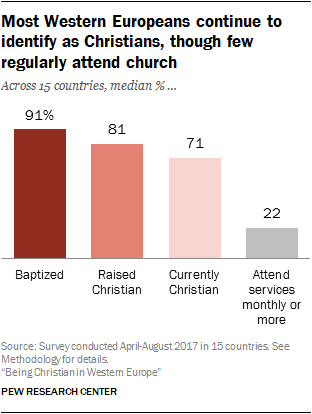 Western Europe, where Protestant Christianity originated and Catholicism has been based for well-nigh of its history, has become i of the world's nearly secular regions. Although the vast bulk of adults say they were baptized, today many do not describe themselves as Christians. Some say they gradually drifted away from faith, stopped believing in religious teachings, or were alienated by scandals or church positions on social issues, according to a major new Pew Enquiry Eye survey of religious beliefs and practices in Western Europe.
Even so about adults surveyed however exercise consider themselves Christians, even if they seldom go to church. Indeed, the survey shows that non-practicing Christians (defined, for the purposes of this study, equally people who identify as Christians, but attend church building services no more a few times per twelvemonth) make up the biggest share of the population across the region. In every country except Italy, they are more numerous than church-attending Christians (those who go to religious services at least one time a month). In the United Kingdom, for example, at that place are roughly 3 times as many non-practicing Christians (55%) as there are church-attending Christians (18%) defined this way.
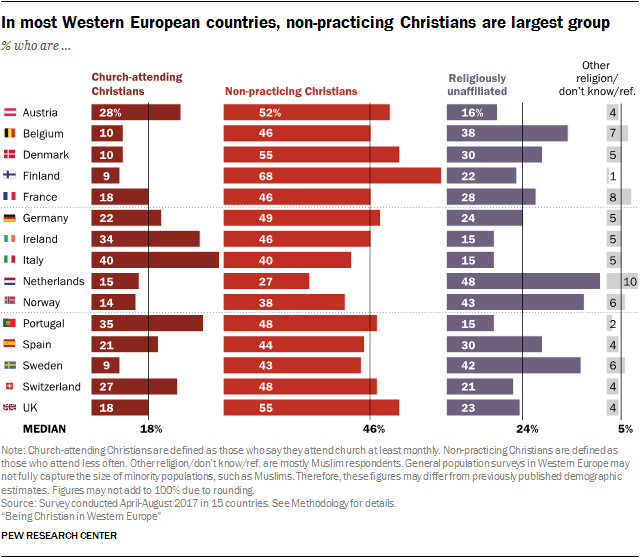
 Non-practicing Christians also outnumber the religiously unaffiliated population (people who place as atheist, doubter or "zippo in particular," sometimes chosen the "nones") in virtually of the countries surveyed.1 And, fifty-fifty after a recent surge in immigration from the Middle E and N Africa, there are many more than non-practicing Christians in Western Europe than people of all other religions combined (Muslims, Jews, Hindus, Buddhists, etc.).
These figures enhance some obvious questions: What is the meaning of Christian identity in Western Europe today? And how different are not-practicing Christians from religiously unaffiliated Europeans – many of whom besides come up from Christian backgrounds?
The Pew Research Middle written report – which involved more than 24,000 telephone interviews with randomly selected adults, including nearly 12,000 non-practicing Christians – finds that Christian identity remains a meaningful mark in Western Europe, even among those who seldom go to church. It is not only a "nominal" identity devoid of practical importance. On the contrary, the religious, political and cultural views of non-practicing Christians oftentimes differ from those of church building-attending Christians and religiously unaffiliated adults. For case:
- Although many non-practicing Christians say they exercise not believe in God "as described in the Bible," they do tend to believe in some other higher power or spiritual force. Past contrast, most church-attention Christians say they believe in the biblical depiction of God. And a clear majority of religiously unaffiliated adults do non believe in whatever blazon of higher power or spiritual forcefulness in the universe.
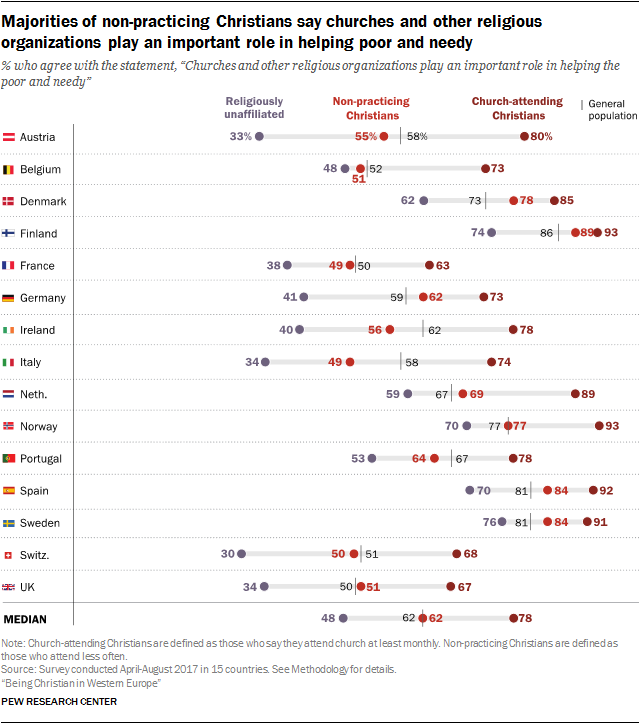
- Non-practicing Christians tend to express more positive than negative views toward churches and religious organizations, saying they serve order past helping the poor and bringing communities together. Their attitudes toward religious institutions are non quite as favorable every bit those of church-attending Christians, but they are more likely than religiously unaffiliated Europeans to say churches and other religious organizations contribute positively to gild.
- Christian identity in Western Europe is associated with higher levels of negative sentiment toward immigrants and religious minorities. On balance, self-identified Christians – whether they attend church building or not – are more likely than religiously unaffiliated people to express negative views of immigrants, as well as of Muslims and Jews.
- Non-practicing Christians are less likely than church-attending Christians to express nationalist views. Nonetheless, they are more likely than "nones" to say that their culture is superior to others and that it is necessary to have the land's ancestry to share the national identity (e.g., ane must accept Spanish family background to be truly Spanish).
- The vast majority of non-practicing Christians, like the vast majority of the unaffiliated in Western Europe, favor legal abortion and same-sex marriage. Church building-attending Christians are more bourgeois on these problems, though even among churchgoing Christians, in that location is substantial back up – and in several countries, majority support – for legal abortion and same-sexual practice wedlock.
- Nearly all churchgoing Christians who are parents or guardians of minor children (those under 18) say they are raising those children in the Christian faith. Among not-practicing Christians, somewhat fewer – though still the overwhelming majority – say they are bringing upwards their children as Christians. Past dissimilarity, religiously unaffiliated parents by and large are raising their children with no religion.
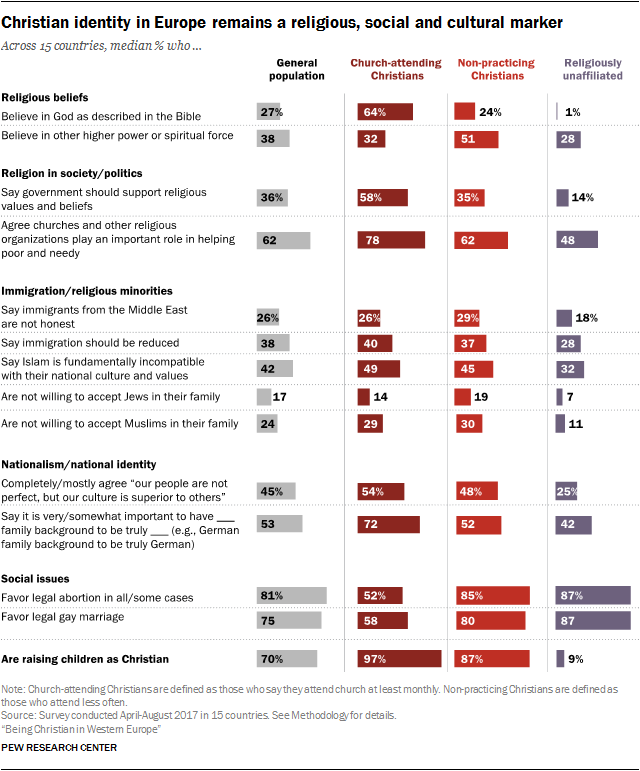
Religious identity and do are not the only factors behind Europeans' beliefs and opinions on these issues. For instance, highly educated Europeans are generally more accepting of immigrants and religious minorities, and religiously unaffiliated adults tend to have more years of schooling than not-practicing Christians. But even after statistical techniques are used to control for differences in education, age, gender and political ideology, the survey shows that churchgoing Christians, non-practicing Christians and unaffiliated Europeans express different religious, cultural and social attitudes. (See below in this overview and Chapter 1.)
These are among the primal findings of a new Pew Enquiry Centre survey of 24,599 randomly selected adults across fifteen countries in Western Europe. Interviews were conducted on mobile and landline telephones from April to Baronial, 2017, in 12 languages. The survey examines not just traditional Christian religious beliefs and behaviors, opinions about the part of religious institutions in order, and views on national identity, immigrants and religious minorities, but too Europeans' attitudes toward Eastern and New Age spiritual ideas and practices. And the 2nd half of this Overview more closely examines the beliefs and other characteristics of the religiously unaffiliated population in the region.
While the vast majority of Western Europeans identify every bit either Christian or religiously unaffiliated, the survey also includes interviews with people of other (non-Christian) religions as well as with some who turn down to reply questions about their religious identity. But, in most countries, the survey'southward sample sizes do not allow for a detailed analysis of the attitudes of people in this grouping. Furthermore, this category is equanimous largely of Muslim respondents, and general population surveys may underrepresent Muslims and other small religious groups in Europe because these minority populations often are distributed differently throughout the country than is the full general population; additionally, some members of these groups (especially contempo immigrants) do not speak the national language well enough to participate in a survey. As a result, this report does not attempt to characterize the views of religious minorities such equally Muslims, Jews, Buddhists or Hindus in Western Europe.
What is a median?
On many questions throughout this report, median percentages are reported to help readers see overall patterns. The median is the middle number in a list of figures sorted in ascending or descending lodge. In a survey of 15 countries, the median event is the eighth on a listing of country-level findings ranked in order.
Non-practicing Christians widely believe in God or another higher power
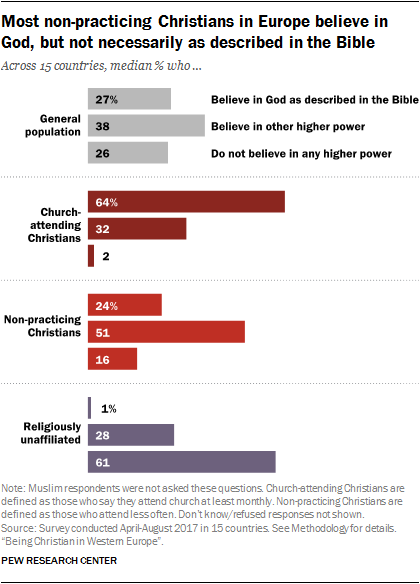 Most non-practicing Christians in Europe believe in God. Merely their concept of God differs considerably from the way that churchgoing Christians tend to conceive of God. While most church-attention Christians say they believe in God "as described in the Bible," non-practicing Christians are more apt to say that they practice not believe in the biblical depiction of God, merely that they believe in some other higher power or spiritual strength in the universe.
For instance, in Cosmic-majority Spain, only about one-in-five non-practicing Christians (21%) believe in God "as described in the Bible," while half-dozen-in-x say they believe in some other college ability or spiritual force.
Non-practicing Christians and "nones" too diverge sharply on this question; most unaffiliated people in Western Europe do not believe in God or a higher power or spiritual force of any kind. (Run into below for more details on belief in God among religiously unaffiliated adults.)
Similar patterns – in which Christians tend to concur spiritual beliefs while "nones" do non – prevail on a variety of other beliefs, such as the possibility of life after death and the notion that humans accept souls apart from their physical bodies. Majorities of non-practicing Christians and church-attending Christians believe in these ideas. Most religiously unaffiliated adults, on the other mitt, decline belief in an afterlife, and many do not believe they have a soul.
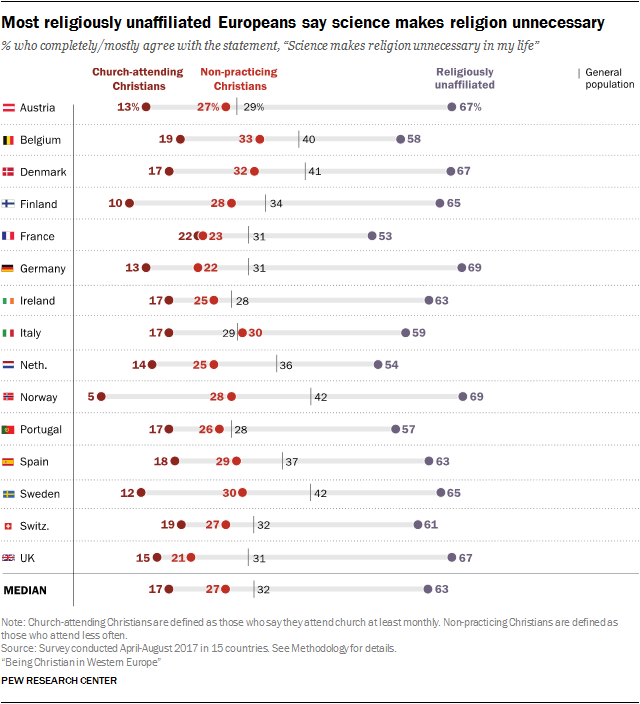
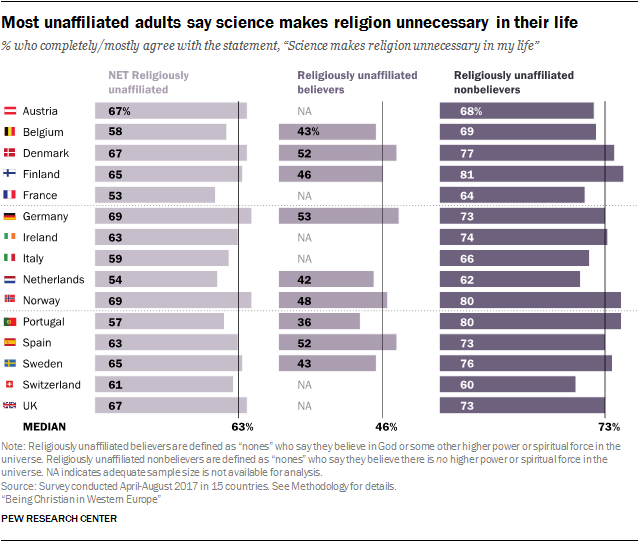
Indeed, many religiously unaffiliated adults eschew spirituality and religion entirely. Majorities hold with the statements, "There are no spiritual forces in the universe, but the laws of nature" and "Science makes religion unnecessary in my life." These positions are held by smaller shares of church building-attending Christians and non-practicing Christians, though in most countries roughly a quarter or more of non-practicing Christians say science makes religion unnecessary to them. (For a detailed statistical analysis combining multiple questions into scales of religious commitment and spirituality, encounter Chapters 3 and 5.)
Views on human relationship betwixt authorities and organized religion
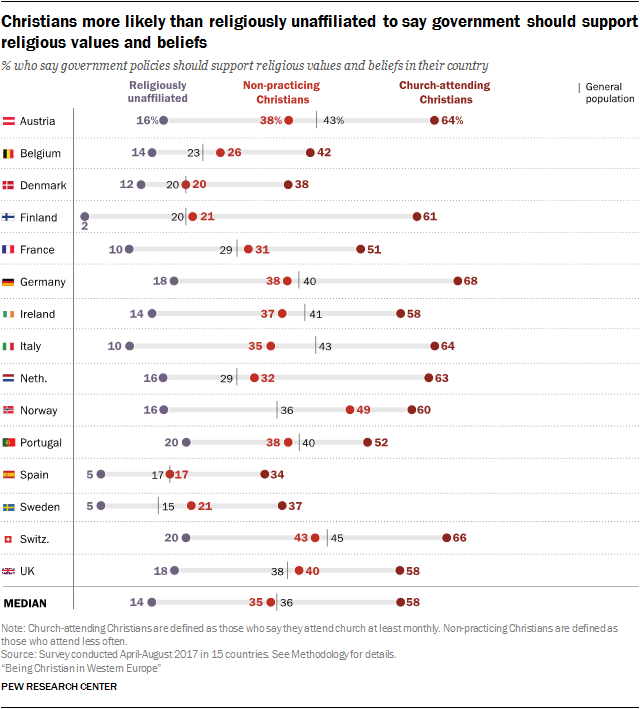
Generally speaking, Western Europeans exercise not expect favorably on entanglements between their governments and religion. Indeed, the predominant view in all 15 countries surveyed is that religion should be kept separate from government policies (median of 60%), every bit opposed to the position that government policies should support religious values and beliefs in their country (36%).
Not-practicing Christians tend to say religion should be kept out of authorities policy. Even so, substantial minorities (median of 35%) of non-practicing Christians remember the authorities should back up religious values and behavior in their state – and they are much more probable than religiously unaffiliated adults to take this position. For instance, in the United Kingdom, 40% of non-practicing Christians say the government should support religious values and beliefs, compared with xviii% of "nones."
In every state surveyed, church building-attending Christians are much more likely than non-practicing Christians to favor government support for religious values. In Austria, for example, a majority (64%) of churchgoing Christians take this position, compared with 38% of non-practicing Christians.
The survey also gauged views on religious institutions, asking whether respondents agree with three positive statements nearly churches and other religious organizations – that they "protect and strengthen morality in club," "bring people together and strengthen community bonds," and "play an important function in helping the poor and needy." Three similar questions asked whether they concur with negative assessments of religious institutions – that churches and other religious organizations "are too involved with politics," "focus too much on rules," and "are too concerned with coin and ability."
Once again, there are marked differences of opinion on these questions amidst Western Europeans across categories of religious identity and practise. Throughout the region, non-practicing Christians are more probable than religiously unaffiliated adults to voice positive opinions of religious institutions. For instance, in Germany, a majority of non-practicing Christians (62%) agree that churches and other religious organizations play an important role in helping the poor and needy, compared with fewer than half (41%) of "nones."
Church-attending Christians hold especially positive opinions about the role of religious organizations in society. For instance, almost 3-in-4 churchgoing Christians in Belgium (73%), Germany (73%) and Italia (74%) agree that churches and other religious institutions play an important part in helping the poor and needy. (For more than analysis of results on these questions, see Chapter half-dozen.)
Both non-practicing and churchgoing Christians are more likely than the unaffiliated to concur negative views of immigrants, Muslims and Jews
The survey, which was conducted following a surge of clearing to Europe from Muslim-majority countries, asked many questions about national identity, religious pluralism and immigration.
Well-nigh Western Europeans say they are willing to accept Muslims and Jews in their neighborhoods and in their families, and nearly turn down negative statements about these groups. And, on residual, more respondents say immigrants are honest and hardworking than say the reverse.
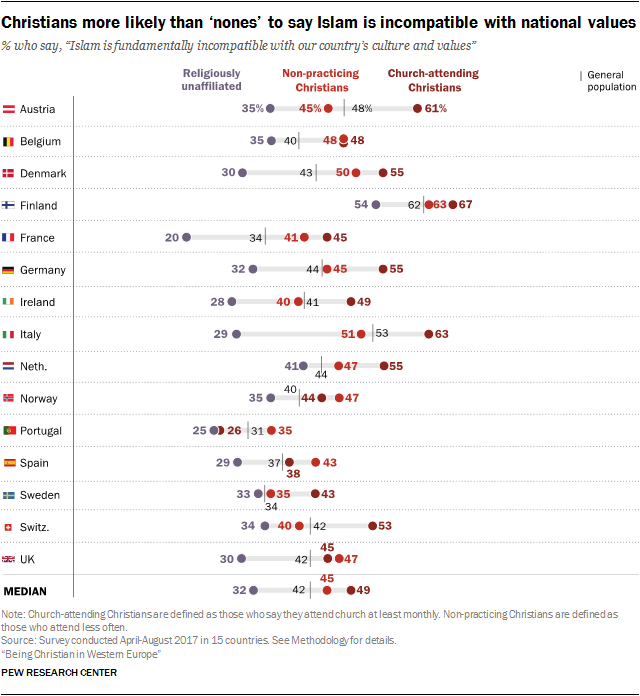
But a clear pattern emerges: Both church-attention and non-practicing Christians are more than probable than religiously unaffiliated adults in Western Europe to voice anti-immigrant and anti-minority views.
For example, in the Great britain, 45% of church-attending Christians say Islam is fundamentally incompatible with British values and civilisation, as do roughly the same share of non-practicing Christians (47%). But among religiously unaffiliated adults, fewer (30%) say Islam is fundamentally incompatible with their country's values. There is a similar design beyond the region on whether there should exist restrictions on Muslim women's clothes, with Christians more probable than "nones" to say Muslim women should non be allowed to clothing whatever religious wear.
Although electric current debates on multiculturalism in Europe often focus on Islam and Muslims, there also are long-continuing Jewish communities in many Western European countries. The survey finds Christians at all levels of religious observance are more likely than religiously unaffiliated adults to say they would not exist willing to accept Jews in their family, and, on rest, they are somewhat more likely to agree with highly negative statements about Jews, such as, "Jews ever pursue their own interests, and not the interest of the land they alive in." (For farther analysis of these questions, encounter Chapter one.)
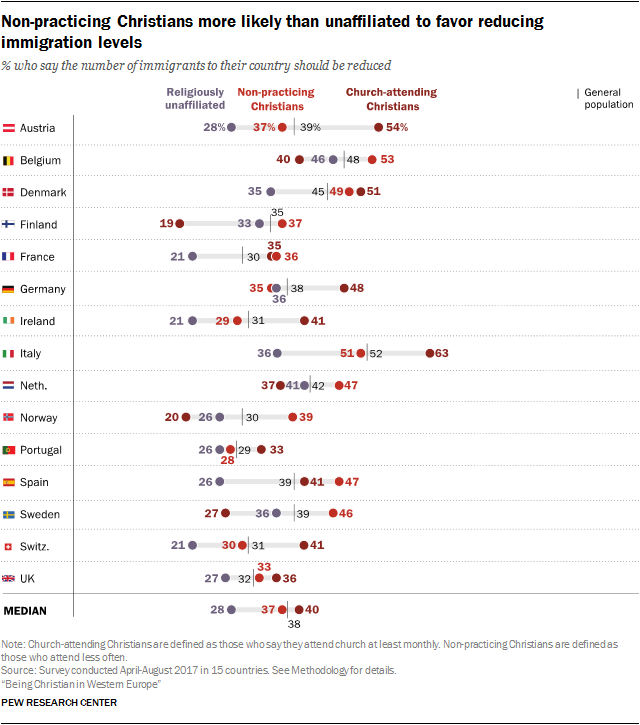
When it comes to immigration, Christians – both churchgoing and non-practicing – are more likely than "nones" in Europe to say immigrants from the Middle East and Africa are not honest or hardworking, and to favor reducing clearing from current levels.2 For example, 35% of churchgoing Christians and 36% of not-practicing Christians in French republic say immigration to their country should exist reduced, compared with 21% of "nones" who take this position.
There are, even so, exceptions to this general pattern. In a few places, church-attending Christians are more than accepting of immigration and less likely to say immigration should be reduced. In Republic of finland, for example, only one-in-five churchgoing Christians favor reducing clearing (xix%), compared with larger shares among religiously unaffiliated adults (33%) and not-practicing Christians (37%).
But overall, anti-immigrant, anti-Muslim and anti-Jewish opinions are more common among Christians, at all levels of exercise, than they are among Western Europeans with no religious affiliation. This is not to say that most Christians hold these views: On the opposite, by most measures and in most countries surveyed, only minorities of Christians voice negative opinions well-nigh immigrants and religious minorities.
There also are other factors beyond religious identity that are closely continued with views on immigration and religious minorities. For instance, higher education and personally knowing someone who is Muslim tend to go paw in hand with more openness to immigration and religious minorities. And identifying with the political right is strongly linked to anti-immigration stances.
Still, even after using statistical techniques to control for a broad variety of factors (age, instruction, gender, political ideology, personally knowing a Muslim or a Jewish person, personal assessments of economic well-beingness, satisfaction with the country's general management, etc.), Western Europeans who place as Christian are more likely than those who take no religious affiliation to express negative feelings about immigrants and religious minorities.
Are Christian identity and Muslim immigration linked? The broader debate in Europe
Pew Enquiry Center's survey of Western Europe was conducted in the spring and summer of 2017, following the two highest years of asylum applications on record. Some scholars and commentators take asserted that the influx of refugees, including many from Muslim-bulk countries, is spurring a revival of Christian identity. Rogers Brubaker, a professor of folklore at UCLA, calls this a reactive Christianity in which highly secular Europeans are looking at new immigrants and saying, in outcome: "If 'they' are Muslim, then in some sense 'we' must be Christian."
The survey – a kind of snapshot in time – cannot evidence that Christian identity is now growing in Western Europe after decades of secularization. Nor can it bear witness (or disprove) the exclamation that if Christian identity is growing, immigration of not-Christians is the reason.
But the survey can help answer the question: What is the nature of Christian identity in Western Europe today, peculiarly among the big population that identifies equally Christian merely does not regularly go to church? As explained in greater particular throughout this written report, the findings suggest that the answer is partly a matter of religious beliefs, partly a affair of attitudes toward the function of religion in society, and partly a thing of views on national identity, immigrants and religious minorities.
This confluence of factors may not surprise shut observers of European politics. Olivier Roy, a French political scientist who studies both Islam and secularization, writes that, "If the Christian identity of Europe has get an issue, it is precisely because Christianity every bit faith and practices faded away in favor of a cultural marker which is more and more than turning into a neo-ethnic marker ('true' Europeans versus 'migrants')."
Some commentators have expressed strong misgivings about the promotion of "cultural" Christian identity in Europe, seeing it as driven largely by fearfulness and misunderstanding. In the "present context of high levels of fearfulness of and hostility to Muslims," writes Tariq Modood, professor of folklore, politics and public policy at the University of Bristol in the United kingdom of great britain and northern ireland, efforts to develop cultural Christianity as an "ideology to oppose Islam" are both a challenge to pluralism and equality, and "a chance to democracy."
Others see a potential revival of Christianity in Western Europe as a bulwark against extremism. While calling himself an "incurable atheist," the British historian Niall Ferguson said in a 2006 interview that "organised Christianity, both in terms of observance and in terms of faith, sail[ed] off a cliff in Europe sometime in the 1970s, 1980s," leaving European societies without "religious resistance" to radical ideas. "In a secular lodge where nobody believes in anything terribly much except the side by side shopping spree, it's actually quite easy to recruit people to radical, monotheistic positions," Ferguson said.
But not everyone agrees on immigration's touch on. British author and lecturer Ronan McCrea contends that Muslim migration is making Europe more than secular, not less. "Previously, many of those who are not especially religious were content to describe themselves as Christian on cultural grounds," he writes. "Just every bit religion and national identity have gradually begun to separate, religious identity becomes more than a question of credo and belief than membership of a national community. This has encouraged those who are non true believers to move from a nominal Christian identity to a more than conspicuously not-religious one."
In Western Europe, religion strongly associated with nationalist sentiment
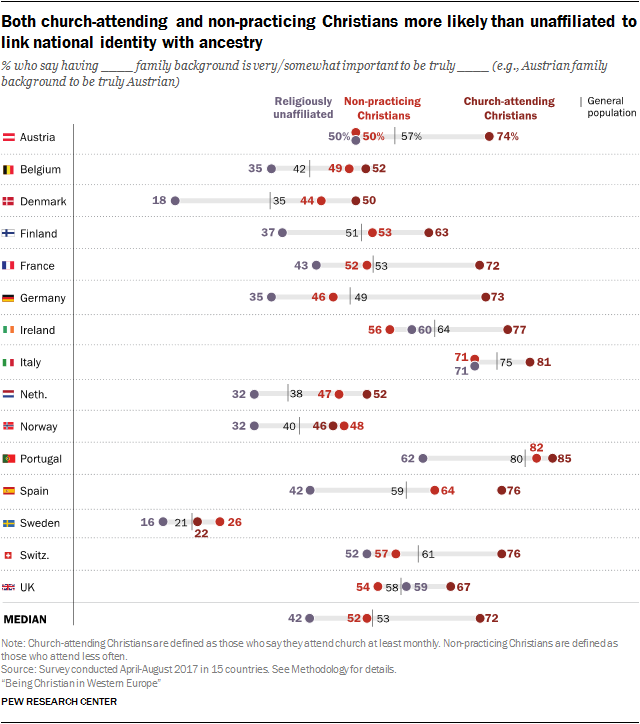
Overall levels of nationalism vary considerably across the region.three For case, solid majorities in some countries (such every bit Italia and Portugal) and fewer than half in others (such every bit Sweden and Denmark) say that it is of import to have ancestors from their country to truly share the national identity (e.g., to accept Danish ancestry to exist truly Danish).
Within countries, non-practicing Christians are less likely than churchgoing Christians to say that ancestry is key to national identity. And religiously unaffiliated people are less probable than both churchgoing and not-practicing Christians to say this.
For instance, in France, nearly iii-quarters of church building-attending Christians (72%) say it is of import to have French ancestry to be "truly French." Amongst non-practicing Christians, 52% have this position, merely this is nevertheless higher than the 43% of religiously unaffiliated French adults who say having French family unit background is important in gild to exist truly French.
Both not-practicing and churchgoing Christians are more likely than "nones" to concord with the argument, "Our people are not perfect, but our culture is superior to others." And additional statistical analysis shows that this holds true even later on decision-making for age, gender, education, political ideology and other factors.
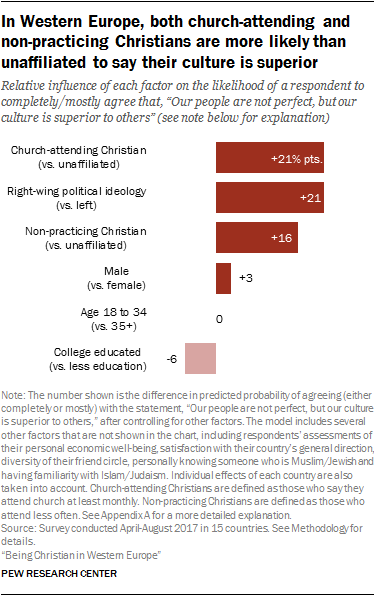 In other words, Christians as a whole in Western Europe tend to express higher levels of nationalist sentiment. This overall pattern is non driven past nationalist feelings solely amongst highly religious Christians or solely amongst non-practicing Christians. Rather, at all levels of religious observance, these views are more common amid Christians than amid religiously unaffiliated people in Europe.
Altogether, the survey asked more than 20 questions near possible elements of nationalism, feelings of cultural superiority, attitudes toward Jews and Muslims, views on immigrants from various regions of the earth, and overall levels of clearing. Many of these views are highly correlated with each other. (For example, people who limited negative attitudes toward Muslims and Jews are besides more likely to express negative attitudes toward immigrants, and vice versa.) As a result, researchers were able to combine 22 individual questions into a scale measuring the prevalence of nationalist, anti-immigrant and anti-minority sentiments in each country and to conduct additional statistical analysis of the factors associated with these sentiments in Western Europe today. For details of this analysis, run into Chapter i.
Same-sexual practice marriage, abortion widely accustomed by not-practicing Christians
Vast majorities of non-practicing Christians and religiously unaffiliated adults beyond Western Europe favor legal abortion and aforementioned-sex wedlock. In some countries, there is not much difference on these questions between the attitudes of Christians who rarely nourish church and adults who practise not affiliate with whatsoever organized religion.
In every country surveyed, on the other mitt, church building-attention Christians are considerably more than conservative than both non-practicing Christians and religiously unaffiliated adults on questions about abortion and same-sex spousal relationship.
Education has a strong influence on attitudes on both bug: College-educated respondents are considerably more likely than those with less education to favor legal abortion and same-sexual practice union. On balance, women are more probable than men to favor legal gay marriage, but their attitudes are largely similar on ballgame.
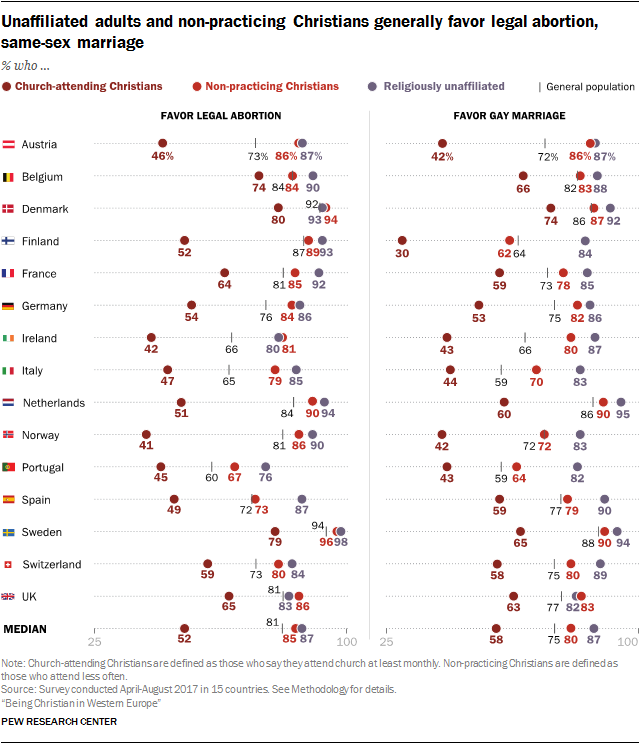
Summing up: On what problems do not-practicing Christians resemble 'nones'? And on what measures are they similar to church-attention Christians?
While the religious, political and cultural views of non-practicing Christians in Western Europe are oftentimes distinct from those of church-attending Christians and religiously unaffiliated adults ("nones"), on some problems non-practicing Christians resemble churchgoing Christians, and on others they largely marshal with "nones."
Religious beliefs and attitudes toward religious institutions are two areas of wide similarity betwixt non-practicing Christians and church-attention Christians. Most non-practicing Christians say they believe in God or some higher power, and many recollect that churches and other religious organizations make positive contributions to club. In these respects, their perspective is similar to that of churchgoing Christians.
On the other manus, abortion, gay wedlock and the role of religion in regime are 3 areas where the attitudes of non-practicing Christians broadly resemble those of religiously unaffiliated people ("nones"). Solid majorities of both not-practicing Christians and "nones" say they retrieve that abortion should be legal in all or nearly cases and that gays and lesbians should be allowed to marry legally. In addition, most non-practicing Christians, forth with the vast bulk of "nones," say religion should be kept out of authorities policies.
When asked whether it is important to have been born in their country, or to have family unit groundwork there, to truly share the national identity (e.g., important to have Spanish beginnings to be truly Spanish), non-practicing Christians mostly are somewhere in betwixt the religiously unaffiliated population and church-attending Christians, who are nigh inclined to link birthplace and ancestry with national identity.
Many in all three groups turn down negative statements about immigrants and religious minorities. But non-practicing Christians and church building-attending Christians are generally more probable than "nones" to favor lower levels of immigration, to limited negative views toward immigrants from the Center East and sub-Saharan Africa, and to agree with negative statements about Muslims and Jews such every bit, "In their hearts, Muslims desire to impose their religious police force on everyone else" in their country or "Jews ever pursue their ain interests and not the interest of the land they live in."(For farther analysis of these questions, see Chapter one.)
Overall, the study shows a strong clan between Christian identity and nationalist attitudes, equally well every bit views of religious minorities and clearing, and a weaker association between religious commitment and these views. This finding holds regardless of whether religious commitment amid Christians is measured through church attendance solitary, or using a scale that combines omnipresence with three other measures: conventionalities in God, frequency of prayer and importance of organized religion in a person's life. (See Affiliate 3 for a detailed analysis of the scale of religious commitment.)
Religious observance and attitudes toward minorities among Catholics and Protestants in Western Europe
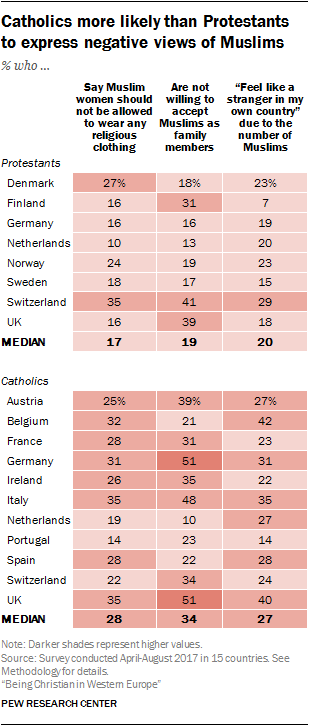 Although people in some predominantly Catholic countries in Europe, including Portugal and Italia, are more religiously observant than others in the region, Catholics and Protestants overall in Western Europe display similar overall levels of observance.
But Catholics and Protestants in the region differ in their attitudes toward religious minorities. For example, Catholics are more likely than Protestants to hold negative views of Muslims: Catholics are more likely than Protestants to say they would not be willing to accept Muslims as family members, that Muslim women in their land should not be allowed to wear any religious clothing, and that they concur with the statement, "Due to the number of Muslims hither, I feel like a stranger in my own country."
Differences between Catholics and Protestants on these issues can exist difficult to uncrease from historical and geographic patterns in Western Europe, where Catholic-majority countries are primarily full-bodied in the south, while the north is more heavily Protestant. But in a handful of countries with substantial populations of both Catholics and Protestants – including the United Kingdom and Germany – more Catholics than Protestants concord negative attitudes toward Muslims. For example, in the Uk, 35% of Catholics and 16% of Protestants say Muslim women in their country should not be allowed to wear whatsoever religious clothing. In Switzerland, yet, the contrary is true; 35% of Swiss Protestants limited this view, compared with 22% of Catholics.
Context of the survey
The survey was conducted in mid-2017, after immigration emerged as a front-and-heart upshot in national elections in several Western European countries and as populist, anti-immigration parties questioned the place of Muslims and other religious and ethnic minorities in Germany, France, the Great britain and elsewhere.
Muslims at present make up an estimated 4.9% of the population of the Eu (plus Norway and Switzerland) and somewhat higher shares in some of Western Europe'south virtually populous countries, such equally France (an estimated viii.8%), the UK (vi.3%) and Deutschland (6.1%). These figures are projected to continue to increment in coming decades, fifty-fifty if in that location is no more than immigration to Europe.
The survey asked non merely about attitudes toward Muslims and Jews, just likewise near Catholics' and Protestants' views of ane another. The findings about Protestant-Catholic relations were previously released before the commemoration of the 500th anniversary of the get-go of the Protestant Reformation in Germany.4
This report as well includes cloth from 20 focus groups convened past Pew Enquiry Center in the months following the survey's completion in v of the countries surveyed. The focus groups in French republic, Germany, Spain, Sweden and the Britain provided an opportunity for participants to discuss their feelings about pluralism, immigration, secularism and other topics in more detail than survey respondents typically can give when responding to a questionnaire. Some conclusions from focus groups are included in illustrative sidebars throughout the study.
This report, funded past The Pew Charitable Trusts and the John Templeton Foundation, is function of a larger effort past Pew Inquiry Center to empathise religious change and its impact on societies around the earth. The Heart previously has conducted religion-focused surveys across sub-Saharan Africa; the Middle East-North Africa region and many other countries with large Muslim populations; Latin America; Israel; Central and Eastern Europe; and the United States.
The balance of this Overview examines what information technology means to be a "none" in Western Europe, including the extent of religious switching from Christianity to the ranks of the religiously unaffiliated and the reasons "nones" requite for leaving their childhood faith. Information technology besides looks at their beliefs about religion and spirituality, including a closer expect at the attitudes of religiously unaffiliated adults who say they practise believe there is a God or some other higher power or spiritual force in the universe.
Europe'due south irresolute religious landscape: Declines for Christians, gains for unaffiliated
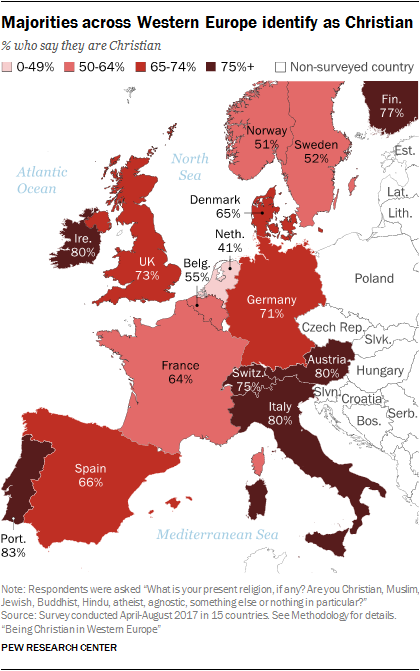
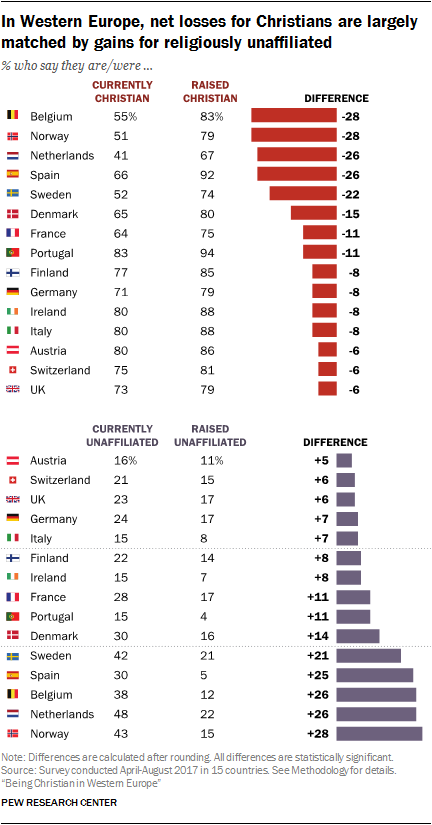 Nigh people in Western Europe describe themselves as Christians. But the percentage of Christians appears to have declined, especially in some countries. And the net losses for Christianity have been accompanied by cyberspace growth in the numbers of religiously unaffiliated people.
Across the region, fewer people say they are Christian now than say they were raised as Christians. The opposite is true of religiously unaffiliated adults – many more people currently are religiously unaffiliated than the share who were raised with no religion (i.east., every bit atheist, agnostic or "cypher in detail"). For example, 5% of adults in Spain say they were raised with no religion, while 30% now fit this category, a deviation of 25 percentage points. The religiously unaffiliated have seen similarly large gains in Kingdom of belgium, the Netherlands, Kingdom of norway and Sweden.
Sidebar: Religious identity in Western Europe over time
Several countries in Western Europe have been collecting census data on organized religion for decades, and these data (from Austria, Finland, Ireland, the Netherlands, Portugal and Switzerland) indicate that the percentage of the population that identifies as Christian has fallen essentially since the 1960s, while the share of the population that does not identify with any religion has risen.five
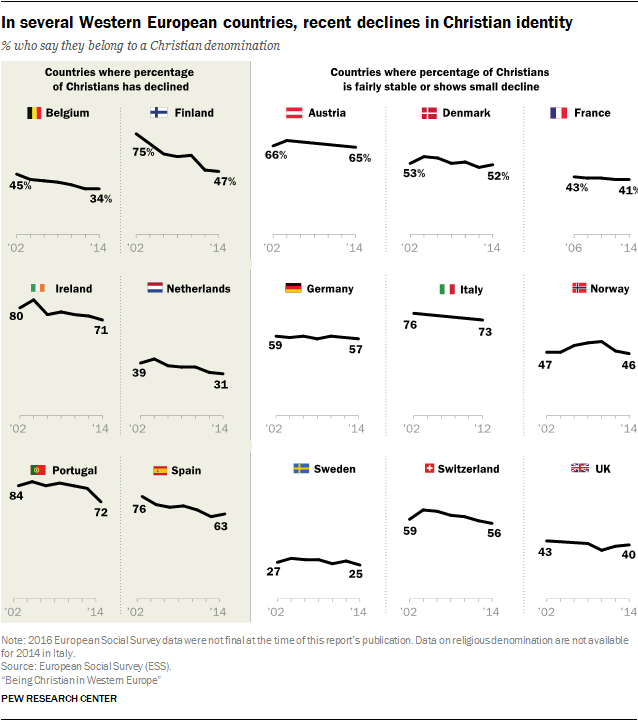
More recent data collected by the European Social Survey (ESS) since 2002 show a continuation of the long-term trend in some countries. Christianity has experienced relatively rapid declines in Belgium, Republic of finland, Ireland, the netherlands, Portugal and Spain. But in the nine other countries included in the Pew Research Heart survey, the ESS finds the share of Christians has either been relatively stable or has declined simply modestly, suggesting that the charge per unit of secularization varies considerably from country to country and may have slowed or leveled off in some places in recent years.
Due to major differences in question wording, the ESS estimates of the percentage of Christians in each country differ considerably from Pew Enquiry Center estimates. The ESS asks what is known every bit a "two-stride" question about religious identity: Respondents starting time are asked, "Do you consider yourself equally belonging to whatever item religion or denomination?" People who say "Yes" are then asked, "Which 1? Roman Catholic, Protestant, Eastern Orthodox, other Christian denomination, Jewish, Islamic, Eastern religions or other non-Christian religions." Pew Research Center surveys ask a "1-stride" question, "What is your present faith, if whatsoever? Are you Christian, Muslim, Jewish, Buddhist, Hindu, atheist, agnostic, something else or nothing in detail?"
Using the ESS question wording and 2-step arroyo consistently yields lower shares of religiously affiliated respondents (including Christians) in Western Europe. For example, in the Netherlands, 31% of respondents identify with a Christian denomination in the 2014 ESS, while in the Pew Research Center survey, 41% identify as Christian. Presumably, this is considering some respondents who are relatively low in religious practice or conventionalities would answer the first question posed by ESS by saying they take no religion, while the same respondents would identify equally Christian, Muslim, Jewish, etc., if presented with a list of religions and asked to cull among them. The impact of these differences in question wording and format may vary considerably from land to state.
Who are Western Europe'south religiously unaffiliated?
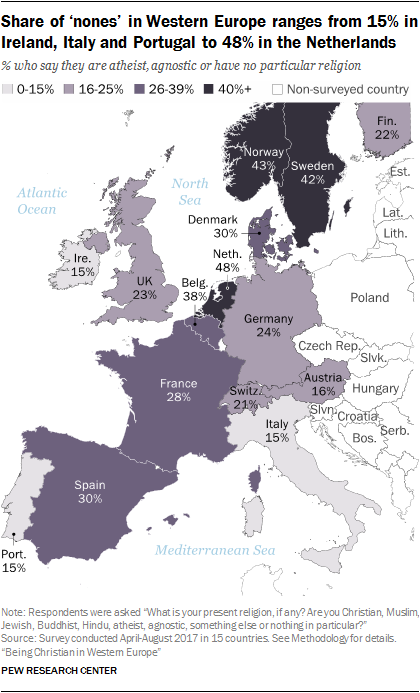
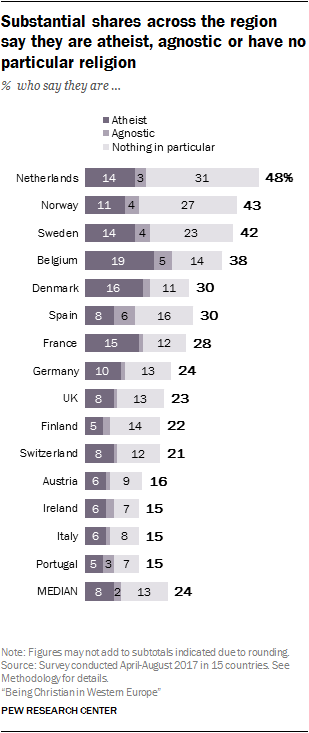
While Christians (taken as a whole) are past far the largest religious group in Western Europe, a substantial minority of the population in every country is religiously unaffiliated – also sometimes called "nones," a category that includes people who place as atheist, doubter or "nothing in item." The unaffiliated portion of the adult population ranges from as high as 48% in kingdom of the netherlands to 15% in Republic of ireland, Italy and Portugal.
 Demographically, "nones" in Western Europe are relatively immature and highly educated, every bit well as disproportionately male person.
Inside the unaffiliated category, those who draw their religious identity as "nil in detail" make up the biggest group (relative to atheists and agnostics) in nigh countries. For instance, fully 3-in-10 Dutch adults (31%) draw their religious identity in this way, compared with xiv% who are self-described atheists and 3% who consider themselves agnostics.
Just in another places, such as Kingdom of belgium, Denmark and France, atheists are at least as numerous every bit those in the "nothing in particular" category. Agnostics, by comparison, have a smaller presence throughout Western Europe.
A bulk of "nones" in most countries surveyed say they were baptized, and many of them also say they were raised as Christians. Overall, more religiously unaffiliated adults in Europe say they were raised Christian (median of 60%) than say they were raised with no religious amalgamation (median of 39%).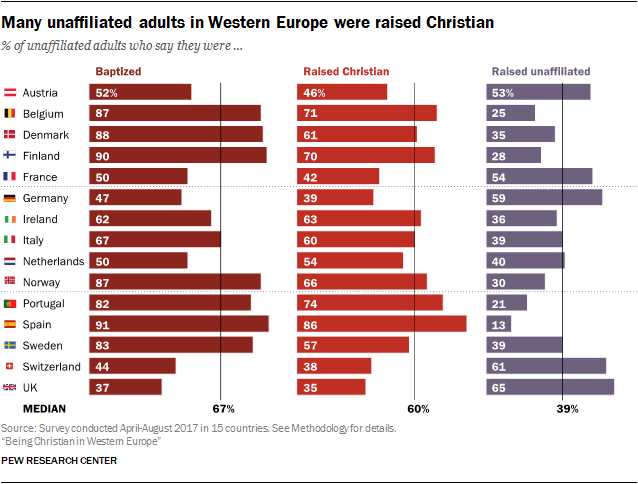
However, these figures vary widely from country to state. For example, the vast majority of unaffiliated adults in Spain (86%) and Portugal (74%) say they were raised every bit Christians. In the UK, by contrast, roughly two-thirds (65%) of adults who currently have no religious affiliation say they were raised that fashion.
What has led Europeans to shed their religious identity?
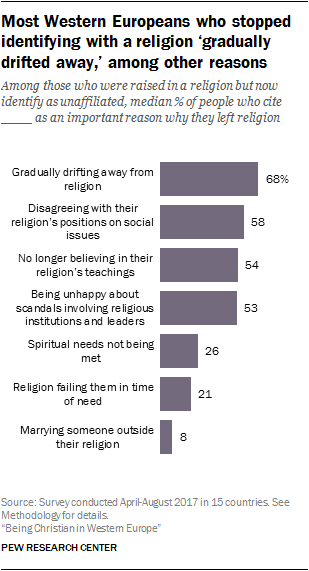 For religiously unaffiliated adults who were raised every bit Christians (or in some other organized religion), the survey posed a series of questions asking almost potential reasons they left religion behind.half-dozen Respondents could select multiple reasons as important factors why they stopped identifying with their childhood religion.
In every country surveyed, most "nones" who were raised in a religious grouping say they "gradually drifted away from religion," suggesting that no 1 particular event or single specific reason prompted this change.7 Many likewise say that they disagreed with church building positions on social issues like homosexuality and abortion, or that they stopped believing in religious teachings. Majorities in several countries, such every bit Spain (74%) and Italy (60%), besides cite "scandals involving religious institutions and leaders" equally an of import reason they stopped identifying every bit Christian (or with some other religious group).
Smaller numbers give other reasons, such every bit that their spiritual needs were not being met, their babyhood religion failed them when they were in need, or they married someone outside their religious group.
For more detail on patterns of religious switching in Western Europe and the reasons people requite for their choices, see Chapter two.
Religiously unaffiliated Europeans tend to limited different attitudes toward Muslims depending on how they were raised
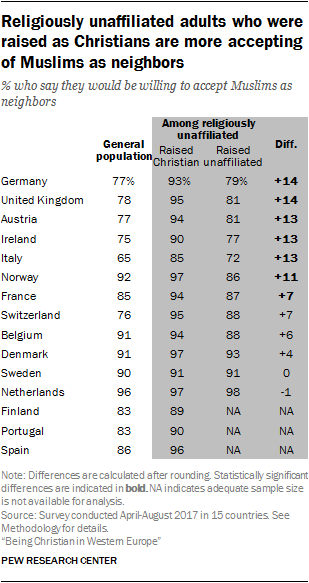 People who have left Christianity in favor of no religious identity may have multiple reasons for doing so. But their attitudes, overall, are more positive toward religious minorities than are the views of either Christians overall or "nones" who say they were raised with no religious identity.
On balance, those who were raised Christian and are at present religiously unaffiliated are less probable than those who were always unaffiliated to say Islam is fundamentally incompatible with their national culture and values, or to take the position that Muslim women in their country should not be allowed to wear religious clothing.
They also are more than probable to limited acceptance of Muslims. For example, in several countries, higher shares of "nones" who were raised Christian than those who were raised unaffiliated say they would be willing to take Muslims as neighbors.
Definitive reasons for this pattern are beyond the telescopic of the information in this study. Only it is possible that some Western Europeans may take given up their religious identity, at to the lowest degree in part, considering information technology was associated with more conservative views on a diversity of bug, such as multiculturalism, sexual norms and gender roles. It also may be that their attitudes toward immigrants shifted along with the modify in their religious identity. Or, it could be that some other, unknown factor (political, economic, demographic, etc.) underlies both their switching from Christian to unaffiliated and their views of immigrants and religious minorities.
Most unaffiliated Europeans exercise non believe in a higher power, but a substantial minority concur some spiritual beliefs
Regardless of how they were raised, "nones" beyond Western Europe seldom partake in traditional religious practices. Few, if any, religiously unaffiliated adults say they attend religious services at least monthly, pray daily, or say religion is "very" or even "somewhat" of import in their lives.
Most "nones" in Western Europe as well affirm they are truly nonbelievers: Not only do majorities in all countries surveyed say they exercise non believe in God, but about also clarify (in a follow-upwards question) that they practise not believe in any higher ability or spiritual force.
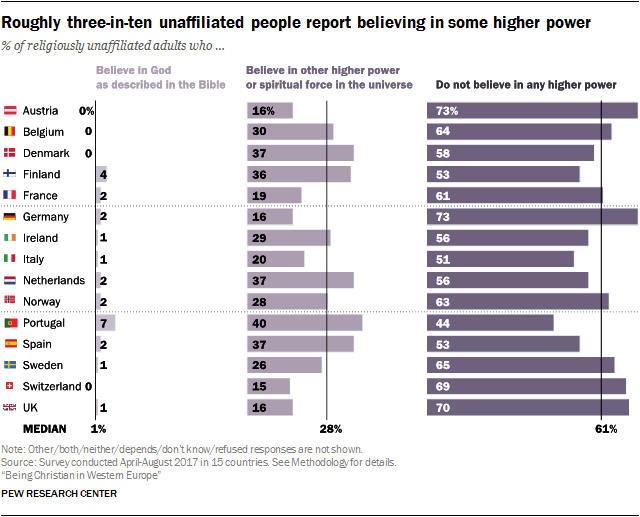
Still, substantial shares of "nones" in all xv countries surveyed, ranging from 15% in Switzerland to 47% in Portugal, express conventionalities in God or some other spiritual strength in the universe. Fifty-fifty though few – if whatever – of these religiously unaffiliated believers say they attend church monthly or pray daily, they express attitudes toward spirituality that are different from those of most other "nones."
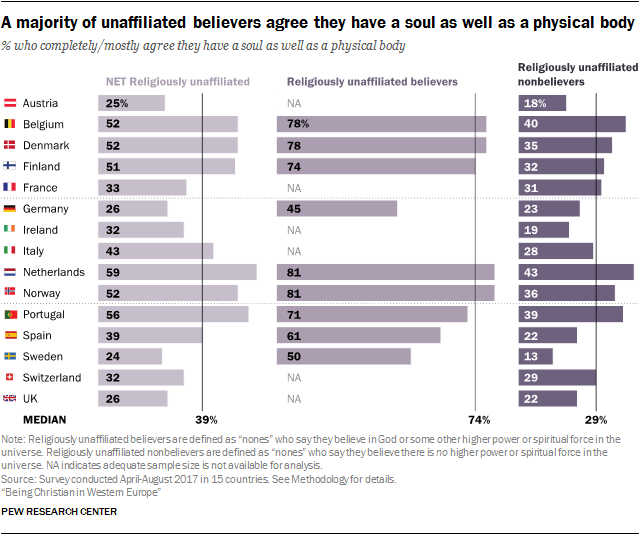
For instance, religiously unaffiliated believers – the subset of "nones" who say they believe in God or some other higher power or spiritual force – are peculiarly probable to believe they take a soul also as a physical body, including roughly eight-in-10 in kingdom of the netherlands and Norway. Amidst the larger grouping of "nones" who practise non believe in any higher ability, belief in a soul is much less common.
The survey also posed questions almost the concepts of fate and reincarnation, and nearly astrology, fortune tellers, meditation, yoga (equally a spiritual practice, not only as do), the "evil eye" and conventionalities in "spiritual energy located in physical things, such equally mountains, trees or crystals." Well-nigh Western European "nones" practice not hold or engage in these beliefs and practices, which are often associated with Eastern, New Historic period or folk religions. But religiously unaffiliated respondents who believe in a higher power or spiritual force are more than probable than those who do non to agree these beliefs.
While many "nones" in Europe express skeptical or negative views about the value of religion, religiously unaffiliated believers are considerably less likely than nonbelievers to hold anti-religious attitudes. For case, in Kingdom of belgium, 43% of assertive "nones" concur that science makes religion unnecessary, compared with 69% of unaffiliated nonbelievers. And in Germany, 35% of unaffiliated believers say that religion causes more impairment than good, compared with 55% of nonbelieving "nones."
Western Europeans are less religious than Americans
The vast majority of adults in the United States, like the majority of Western Europeans, continue to identify as Christian (71%). Simply on both sides of the Atlantic, growing numbers of people say they are religiously unaffiliated (i.eastward., atheist, doubter or "zilch in particular"). About a quarter of Americans (23%, as of 2014) fit this clarification, comparable to the shares of "nones" in the UK (23%) and Federal republic of germany (24%).
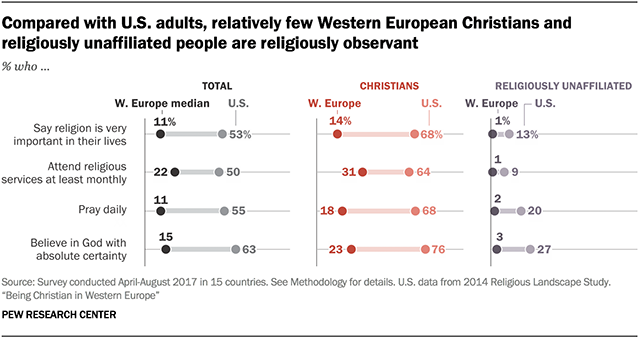
All the same Americans, overall, are considerably more religious than Western Europeans. Half of Americans (53%) say organized religion is "very of import" in their lives, compared with a median of but 11% of adults across Western Europe. Among Christians, the gap is even bigger – 2-thirds of U.Due south. Christians (68%) say faith is very important to them, compared with a median of 14% of Christians in the 15 countries surveyed across Western Europe. But even American "nones" are more religious than their European counterparts. While i-in-8 unaffiliated U.S. adults (13%) say religion is very of import in their lives, hardly any Western European "nones" (median of 1%) share that sentiment.
Similar patterns are seen on conventionalities in God, attendance at religious services and prayer. In fact, by some of these standard measures of religious commitment, American "nones" are as religious equally — or even more religious than — Christians in several European countries, including France, Germany and the United kingdom of great britain and northern ireland.
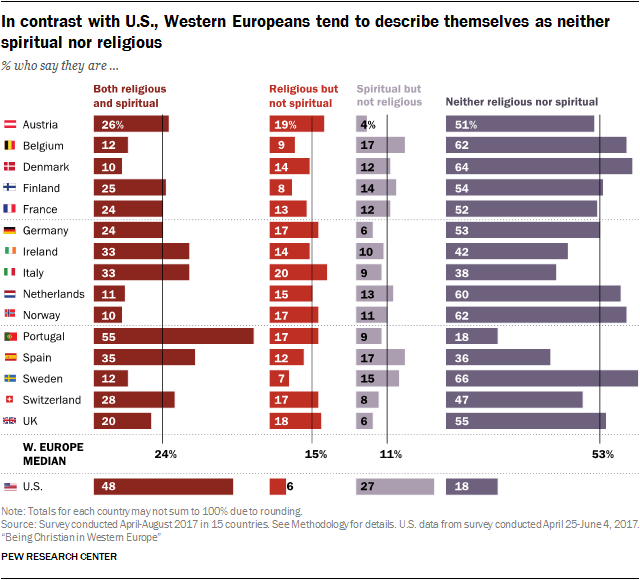
Additionally, the survey asked respondents whether they consider themselves religious and, separately, whether they consider themselves spiritual. These two questions, combined, result in four categories: those who describe themselves as both religious and spiritual, spiritual but not religious, religious but non spiritual, and neither religious nor spiritual.
The largest grouping across Western Europe (a median of 53%) is "neither religious nor spiritual." In nearly every state surveyed, roughly four-in-ten or more adults, including majorities in several countries, say they are neither religious nor spiritual. The biggest exception is Portugal, where more than one-half of adults (55%) say they are both religious and spiritual.
Smaller shares of populations in most countries say they are spiritual but not religious, or religious but not spiritual.
The religious makeup of Western Europe by this measure is significantly different from that of the Us. The largest group in the U.S. is both religious and spiritual (48%), compared with a median of 24% across Western Europe. Americans are also considerably more than likely than Western Europeans to say they think of themselves as spiritual only not religious; 27% of Americans say this, compared with a median of 11% of Western Europeans surveyed.
Very few religiously unaffiliated adults – 2% to 4% in almost every Western European country surveyed – say they consider themselves to be religious people. While somewhat larger shares (median of 19%) consider themselves spiritual, this is still much lower than in the United States, where nearly half of "nones" describe themselves every bit spiritual (including 45% who say they are spiritual only not religious).
A previously published analysis of data from 15 European countries used an older version of survey weights. Since then, Pew Inquiry Center has improved the survey weights for greater accuracy leading to slight differences in some numbers between the ii publications. The noun findings of the previous publication are non afflicted by the revised weights. Please contact the Centre for questions regarding weighting adjustments.
Source: https://www.pewresearch.org/religion/2018/05/29/being-christian-in-western-europe/
Posted by: newellcoughterep61.blogspot.com
0 Response to "What Event Seems To Have Led To A Radical Change In The Ethnic Makeup Of The Church In Rome?"
Post a Comment